

For years, the Tejas Mk1A was billed as the fast, affordable fix for the Indian Air Force’s aging fighter fleet. In 2026, it has instead become the clearest example of the problem it was meant to solve — because the jets keep getting built, but they have nowhere to go without engines.
A Five-Year Wait for Engines
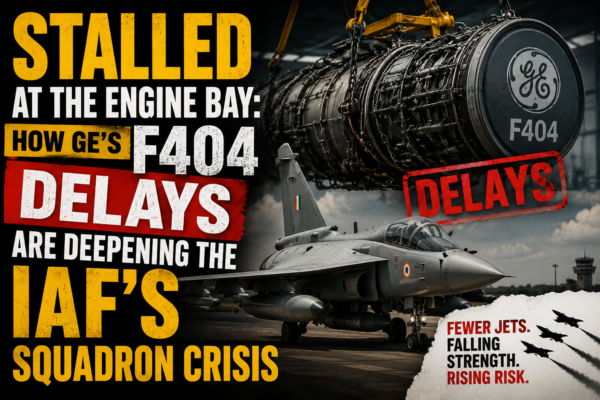
In 2021, Hindustan Aeronautics Limited signed a $716 million contract with GE Aerospace for 99 F404-IN20 engines to power 83 Tejas Mk1A fighters. Nearly five years later, GE has delivered only around six engines. The shortfall traces back to a simple but costly decision: GE shut down its F404 production line in 2016 after an earlier order wrapped up, and when India came back with a much bigger request in 2021, GE had to rebuild that manufacturing capability almost from zero — re-hiring staff, requalifying suppliers, and restarting tooling that had been dormant for years.
Other factors piled on. A South Korean supplier providing critical components became a recurring bottleneck. Demand for F404-family engines has risen globally, straining GE’s output across multiple programs. And ongoing conflict in West Asia has disrupted shipping routes that engines and parts depend on. The result: a contract meant to guarantee steady propulsion has instead become the single biggest constraint on India’s fighter production.
Jets Without Engines
The bottleneck is visible on the ground. HAL has reportedly completed and test-flown several Tejas Mk1A airframes that simply sit waiting for engines to arrive. The company can build jets faster than GE can supply the powerplants to fly them — an awkward position for a manufacturer trying to prove that Indian industry can scale up.
Frustration has turned into financial consequence. In April 2026, HAL confirmed it had begun imposing liquidated damages on GE for each late engine delivery, as allowed under their original contract. Yet the relationship hasn’t fractured — in November 2025, India signed a follow-on order for 113 more engines worth roughly $1 billion, with deliveries not expected to begin until 2027. The Ministry of Defence has also escalated its oversight, with a high-level review involving the Defence Minister and the IAF chief scheduled for September 2026.
A Squadron Shortage at a 60-Year Low
While engines trickle in, the IAF’s force structure has been shrinking on a much faster timeline. The air force now fields roughly 29 to 30 fighter squadrons, against a sanctioned requirement of 42 — the number considered necessary to handle simultaneous threats from China and Pakistan. That’s the lowest squadron count in six decades.
The immediate cause was the long-delayed retirement of the MiG-21 Bison, which flew its final sortie in 2025. The Tejas Mk1A was supposed to replace it on a one-for-one basis, but with deliveries stuck behind the engine shortfall, the IAF has been left managing the gap with aging Jaguars and Mirage 2000s — some kept flying through emergency parts purchases — while newer aircraft remain stuck waiting for propulsion.
What Comes Next
India isn’t relying on Tejas alone to close the gap. Two Rafale squadrons are already operational, the more powerful Tejas Mk2 is in development, and the indigenous AMCA stealth fighter is planned for the late 2030s. But none of these arrive quickly enough to offset the squadron deficit in the near term — and some officials are now discussing raising the squadron target even higher, to 50 or more, based on lessons drawn from recent regional conflicts.
For now, the Tejas Mk1A remains a case study in how dependence on a single foreign supplier can stall even a flagship “indigenous” defense program. Whether the engine pipeline finally stabilizes in 2026 and 2027 will determine how quickly India can rebuild the squadron strength it’s been missing for years.




Leave a Reply