

PM Surya Sarovar Yojana Approved: India to Harness Reservoirs, Canals & Industrial Ponds for Clean Energy
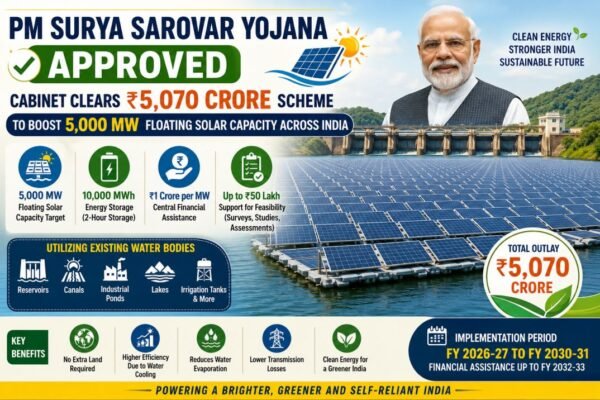
In a major step towards achieving India’s renewable energy goals, the Union Cabinet has approved the Pradhan Mantri Surya Sarovar Yojana (PM-SSY), an ambitious floating solar programme with a total financial outlay of ₹5,070 crore.
The scheme aims to create 5,000 MW of Floating Solar Photovoltaic (FSPV) capacity by utilizing existing reservoirs, canals, lakes, industrial ponds, and other inland water bodies across the country. The initiative is expected to significantly increase clean energy generation while minimizing the need for additional land acquisition.
PM Surya Sarovar Yojana at a Glance
| Particular | Details |
| Scheme Name | Pradhan Mantri Surya Sarovar Yojana (PM-SSY) |
| Approved By | Union Cabinet |
| Total Outlay | ₹5,070 Crore |
| Target Capacity | 5,000 MW Floating Solar Projects |
| Energy Storage | Minimum 10,000 MWh (2-hour storage) |
| Project Period | FY 2026-27 to FY 2030-31 |
| Financial Assistance | ₹1 Crore per MW after commissioning |
| Feasibility Support | Up to ₹50 lakh per project |
What is PM Surya Sarovar Yojana?
The PM Surya Sarovar Yojana is a centrally sponsored initiative designed to accelerate the deployment of floating solar photovoltaic projects integrated with Energy Storage Systems (ESS).
Unlike conventional solar parks that require large tracts of land, floating solar plants are installed on the surface of reservoirs, canals, irrigation tanks, and industrial water bodies. This innovative approach enables clean energy generation while preserving valuable agricultural and industrial land.
Existing Water Bodies Will Be Utilized
One of the biggest highlights of the scheme is the use of existing water infrastructure, including:
- Reservoirs
- Large irrigation canals
- Industrial ponds
- Dams
- Lakes
- Water treatment reservoirs
- Other inland water bodies
This strategy helps avoid land acquisition challenges and promotes efficient use of underutilized water surfaces.
Massive Expansion of Floating Solar Capacity
India currently has around 700 MW of floating solar capacity.
With the implementation of PM Surya Sarovar Yojana, this capacity is expected to increase to nearly 5,700 MW, making India one of the world’s leading markets for floating solar technology.
Key Financial Incentives
The Government has announced attractive financial support under the scheme:
- Central Financial Assistance (CFA): ₹1 crore per MW for eligible commissioned projects.
- Up to ₹50 lakh for project developers to undertake:
- Bathymetric surveys
- Hydrographic studies
- Environmental assessments
- Detailed feasibility reports
- Technical investigations
These measures are intended to reduce project risks and encourage faster implementation.
Integrated Energy Storage System
Unlike many earlier solar initiatives, PM Surya Sarovar Yojana includes mandatory Energy Storage Systems (ESS).
The approved projects will collectively include:
- 10,000 MWh storage capacity
- Minimum 2-hour storage duration
This will help improve grid stability and ensure reliable power supply even during periods of low solar generation.
Benefits of Floating Solar Projects
Floating solar technology offers several advantages over conventional ground-mounted solar plants:
- No requirement for additional land acquisition
- Reduced evaporation from reservoirs
- Improved solar panel efficiency due to natural cooling by water
- Lower algae growth in water bodies
- Better utilization of unused water surfaces
- Reduced transmission losses when located near hydropower stations
- Enhanced renewable energy generation with integrated storage
Implementation Timeline
The Government plans to sanction projects between:
- FY 2026-27
- FY 2030-31
Financial assistance will continue until FY 2032-33, allowing sufficient time for commissioning and completion of approved projects.
Contribution Towards India’s Renewable Energy Goals
The PM Surya Sarovar Yojana aligns with India’s broader clean energy mission by:
- Increasing renewable energy capacity
- Supporting energy security
- Reducing carbon emissions
- Promoting sustainable infrastructure
- Encouraging innovative solar technologies
The initiative is expected to complement other flagship programmes aimed at expanding solar power generation across the country.
Who Will Benefit?
The scheme is expected to benefit:
- State Governments
- Public Sector Undertakings
- Renewable Energy Developers
- Industrial establishments with suitable water bodies
- Power distribution utilities
- Consumers through cleaner electricity and improved grid reliability
Conclusion
The approval of the Pradhan Mantri Surya Sarovar Yojana marks a significant milestone in India’s transition toward sustainable energy. By utilizing existing reservoirs, canals, and industrial ponds for floating solar projects, the Government aims to generate 5,000 MW of clean electricity while conserving land and improving energy reliability.
With substantial financial support, integrated energy storage, and a clear implementation roadmap, the scheme has the potential to transform India’s floating solar sector and strengthen the country’s position as a global renewable energy leader.





Leave a Reply