

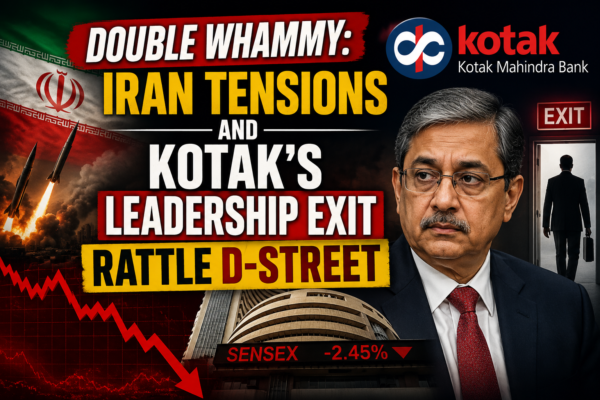
Mumbai, June 29, 2026 — Indian equity markets opened the trading week under pressure, as a fresh flare-up in the Iran conflict and an unexpected leadership change at one of India’s marquee private banks combined to sour investor sentiment on Dalal Street.
Markets Slide as the Iran Ceasefire Cracks
After a brief period of calm last week — during which easing tensions and sliding crude prices had powered the Sensex toward 77,400 — geopolitics reasserted itself over the weekend. The BSE Sensex dropped by more than 400 points, while the Nifty 50 index declined by approximately 115 points as trading resumed on Monday following a long weekend.
The trigger was a renewed exchange of hostilities between the United States and Iran. Iran launched missiles and drones at U.S. military sites in Kuwait and Bahrain over the weekend, prompting renewed U.S. strikes and reviving fears over the Strait of Hormuz supply corridor — just days after a fragile peace had briefly pushed Brent crude back toward pre-war levels. Adding to the unease, the IRGC warned that U.S. strikes had violated the ceasefire and that American bases in the region would face further retaliation in the coming days, even as technical talks were slated to resume in Qatar.
Crude oil — the most direct transmission channel for Middle East risk into Indian markets — duly reacted. Brent crude futures climbed 0.8% to $72.57 a barrel and U.S. WTI rose 1.3% to $70.11 a barrel in early Asian trade, reversing some of the prior week’s sharp decline.
A Broad-Based Sell-Off
The damage on Monday wasn’t confined to the headline indices. On the NSE, 2,034 stocks ended in the red against 1,168 advancers, underscoring that the selling pressure was widespread rather than limited to index heavyweights.
Sector-wise, the classic risk-off playbook played out:
- Banking and auto stocks led the decline, while pharma stocks showed relative resilience
- Nifty Auto, PSU Banks, IT, Cement, and Chemicals faced heavy selling, with many names falling between 1 and 2 per cent, while Nifty Pharma and Healthcare held their ground and the metal sector saw modest gains
- Nifty IT fell 0.66% to 27,151.65, Nifty Energy declined 0.73% to 39,347.35 on oil and gas weakness, and Nifty India Defence dropped 0.94%
The pattern is a familiar one for Indian markets during Middle East flare-ups: when tensions rise, investors typically rotate capital away from cyclical and risk-sensitive assets, anticipating disruptions to global trade, energy supply, or broader economic stability, which pushes money toward defensive sectors like pharma.
Regional markets told a similar story. Japan’s Nikkei 225 fell 1.09% and Indonesia’s JSX Composite dropped 1.72%, with Thailand’s SET Index also lower as the renewed Iran escalation weighed on sentiment across Asia.
This bout of nerves comes after a volatile fortnight for D-Street. Markets had rallied sharply on June 22 after a landmark first round of high-level US-Iran talks in Switzerland offered a dose of geopolitical optimism, then gave up ground later that week on IT-sector weakness, before staging a fresh recovery on June 25 as easing Iran tensions and falling crude oil prices pushed India VIX down 3.38% to 12.93. Monday’s reversal is a reminder of just how quickly that optimism can unwind.
Kotak Mahindra Bank: A Surprise at the Top
Layered on top of the geopolitical jitters was company-specific news that hit one of the Nifty 50’s banking heavyweights directly. Kotak Mahindra Bank announced on Saturday that CEO and Managing Director Ashok Vaswani will not seek reappointment after his term ends on December 31, 2026, citing personal reasons, prompting India’s fourth-largest private lender to begin a search for a successor.
The market’s reaction was swift and negative. Kotak Mahindra Bank shares slipped as much as 3% to ₹395.95 on the NSE on Monday, with the stock later trading down 2.51% at ₹398.75, valuing the bank at roughly ₹3,96,667 crore. Kotak was among the session’s standout laggards on the Nifty 50, alongside Eicher Motors, Tata Consumer Products, and Mahindra & Mahindra.
Why the Market Is Nervous
Vaswani’s exit lands awkwardly for a bank still working to put a turbulent stretch behind it. His departure will mark the second CEO transition in three years at Kotak Mahindra Bank, and comes after a tenure that began with real turbulence: in April 2024, the RBI barred the bank from onboarding new customers through its digital channels and from issuing fresh credit cards, citing deficiencies in its IT risk and information security framework — restrictions that were eventually lifted. The period also saw high-profile exits, including long-serving executive K V S Manian, who left just four months into Vaswani’s tenure, and technology transformation head Milind Nagnur, who departed sooner than expected.
A CEO departure doesn’t directly alter a bank’s balance sheet, but leadership transitions at financial institutions are treated as high-sensitivity events because they can signal shifts in future growth priorities and lending discipline. As one market note put it, an internal appointment would likely signal continuity in strategy, while an external hire could indicate a broader strategic reset.
That succession question is now front and centre. The board is reportedly weighing internal contenders Paritosh Kashyap, a Kotak veteran overseeing wholesale banking, and Anup Saha, both whole-time directors. Brokerages have already started handicapping the race: Nomura named Anup Saha as best placed to succeed Vaswani, arguing that if Saha is the internal choice, the succession path is already substantially de-risked — while flagging that an external hire would be the real risk event, potentially raising questions about the board’s process and creating near-term execution uncertainty. Nomura also noted that Kotak’s board has previously shown a willingness to look outside the bank, having picked Vaswani over senior internal candidates back in 2023, so an external appointment can’t be ruled out.
Despite the stock reaction, both Nomura and ICICI Securities stuck with their bullish calls. Nomura retained a ‘Buy’ rating with a target of ₹460, while ICICI Securities retained ‘Buy’ with a target of ₹480, citing attractive valuations and sectoral tailwinds, and pointing to the lateral hiring of Saha in January 2026 and the May 2025 elevation of Kashyap to executive director as signs that succession planning was already underway.
The Numbers Behind the Noise
The leadership uncertainty arrives despite a respectable set of underlying numbers. Kotak Mahindra Bank reported a 10% rise in consolidated net profit to ₹5,423 crore for Q4 FY26, with standalone net profit up 13% year-on-year to ₹4,027 crore. Core net interest income rose 8% to ₹7,876 crore, net interest margin improved to 4.67% from 4.54% quarter-on-quarter, and net advances grew 16% YoY to ₹4.96 lakh crore as of March 2026. For the full year, though, the picture was more mixed: consolidated profit after tax for FY26 came in at ₹19,103 crore, down from ₹22,126 crore in FY25, even as customer assets grew to ₹6.16 lakh crore from ₹5.37 lakh crore a year earlier.
Stock performance over the medium term has lagged the broader sector. Kotak shares closed at ₹409 last week, down roughly 5% over the past six months and more than 7% over the past year, even as the stock has gained on a longer two-and-a-half-year view. The bank’s market capitalisation stands at approximately ₹4.06 lakh crore.
What to Watch Next
For investors trying to read through Monday’s noise, two separate threads now need tracking:
- Geopolitics and oil: Further movement in the US-Iran standoff, fluctuations in crude oil prices, and the stability of the rupee remain the key swing factors for near-term market direction, given how quickly sentiment has flipped between risk-on and risk-off over the past fortnight.
- Kotak’s succession timeline: A board recommendation on Vaswani’s successor is plausible by September–October 2026, and the market is likely to treat the choice between an internal promotion and an external hire as a meaningful signal about the bank’s strategic direction heading into 2027.
Neither story is fully resolved, which is itself the takeaway: after weeks of markets chasing every headline out of West Asia, Monday’s session was a reminder that geopolitical risk and company-specific governance risk can — and sometimes do — collide on the same trading day.
This article is for informational purposes only and does not constitute investment advice. Market data is as of intraday trade on June 29, 2026, and is subject to change.




Leave a Reply